
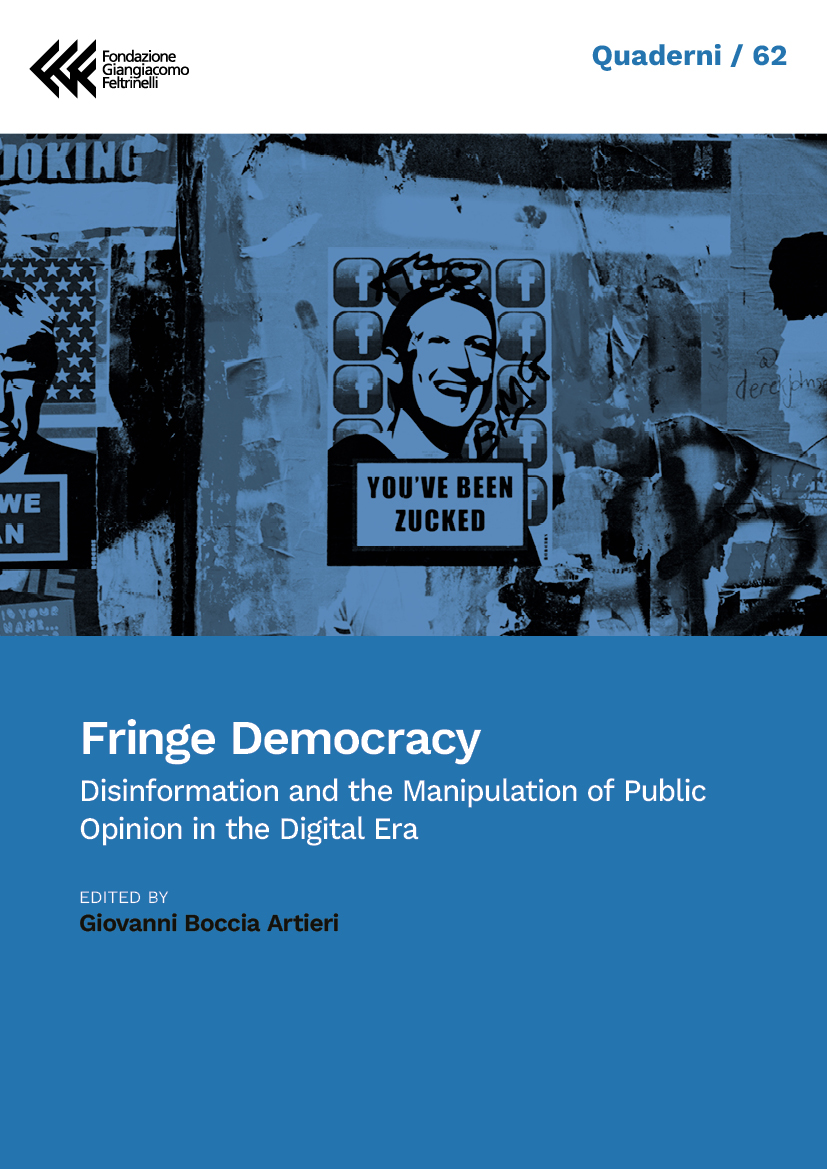
No longer confined to Parliament, television, or newspapers, democracy is now played out in our feeds, across parallel channels of counter-information, and on digital platforms. Here the boundary between truth and narrative grows increasingly blurred.
YouTube, Telegram, X, Reddit, and 4chan have become the infrastructure of the post-public sphere. Hybrid spaces in which new communities take shape, identities are forged, and decisions are made about what deserves attention. Here, algorithms govern the visibility of content, engagement metrics shape the construction of consensus, and the attention economy replaces the economy of argument.
Within this ecosystem, post-truth is not a pathological deviation but a structural condition: what circulates online helps define the boundaries of what can be said, what appears legitimate in political contestation, and what is excluded from public discourse.
From media history to the functioning of algorithms, from investigations into Telegram to conspiracy theories, this volume analyses, deconstructs, and recontextualises the transformations of public communication, offering critical tools to interpret them and practical approaches to counter their more dangerous tendencies.
Fringe platforms and online participatory cultures now reveal new forms of networked power, in which the margins are no longer peripheral but become laboratories of symbolic and political innovation. Understanding what happens at the margins is no longer merely a theoretical exercise: it is an act of democratic care, necessary for navigating today’s information ecosystem with awareness.
Fringe Democracy is the condition in which we now live: the uncertain terrain where it is decided whether democracy can remain a credible promise.
The editor
Giovanni Boccia Artieri is Professor of Sociology of Communication and Digital Media at the University of Urbino Carlo Bo, where he serves as Vice-Rector for Teaching and Communication. He is Director of LaRiCA (Laboratory for Research on Artificial Communication). His research focuses on the transformation of the public sphere in the age of digital media, with particular attention to platforms, algorithms, and participatory culture. He is a member of the Academia Europaea (Film, Media and Visual Studies section) and of the Artificial Intelligence Committee of AgCom, the Italian Communications Regulatory Authority. He is the author of Le teorie delle comunicazioni di massa e la sfida digitale (Rome-Bari, 2019, with S. Bentivegna), Voci della democrazia. Il futuro del dibattito pubblico (Bologna, 2021), and Comunicare. Persone, relazioni, media(Rome-Bari, 2022, with F. Colombo and G. Gili).