

A spectre is haunting the Mediterranean. The spectre of what used to be Our Sea—and which perhaps will never be ours again—is a massive ship, an oil tanker, with a gashed flank, thick with rust, abandoned to the whim of the waters and the wind. It moves, it turns, resigned to the currents.
Two Italian ships follow it, appearing as small as pilot fish on the body of a whale by comparison.
Those who have come close say that the ship “cries,” emitting a grinding screech of teeth and of materials bending and breaking. Even in this reduced state, it inspires fear.
Its name is the Arctic Metagaz, a Russian vessel, and inside its belly are packed 700 tons of oil and 60,000 tons of liquefied gas. If it were to break apart, it would cause a monumental ecological disaster.
Its ordeal began on March 3, in the very first days of the war. It was halfway between Malta and Libya when it was struck by a drone.
The 30 men on board escaped to safety, and the currents carried it away toward Maltese territorial waters first, and yesterday, finally, into Libyan waters. The Italians announced the end of their mission, and now it is up to Libya to defend itself and defend us.
The war has made visible what for a long time seemed only to be signals arriving from the future. But no one accepts the idea that war cannot be confined within the boundaries of a single State, or that war cannot be enclosed within the borders of a single country.
And yet, it has indeed arrived, affecting not only our security but the very places we have always loved. The Great Blue that surrounds us, which over the centuries has given our human race joy and tears, destruction and glory, has formed the backdrop for a thousand stories of many different countries, all united by those waters.
Waters that for nearly a century—following the battle in the Mediterranean that accompanied the defeat of Nazi-Fascism by the Anglo-American army—had been reclaimed, particularly by us Italians, as the geography of happiness.
Today, however, they have once again become an intensely relevant place for the entire world, an area where the balance of three continents is being played out with full military impact.
What is the Mediterranean?
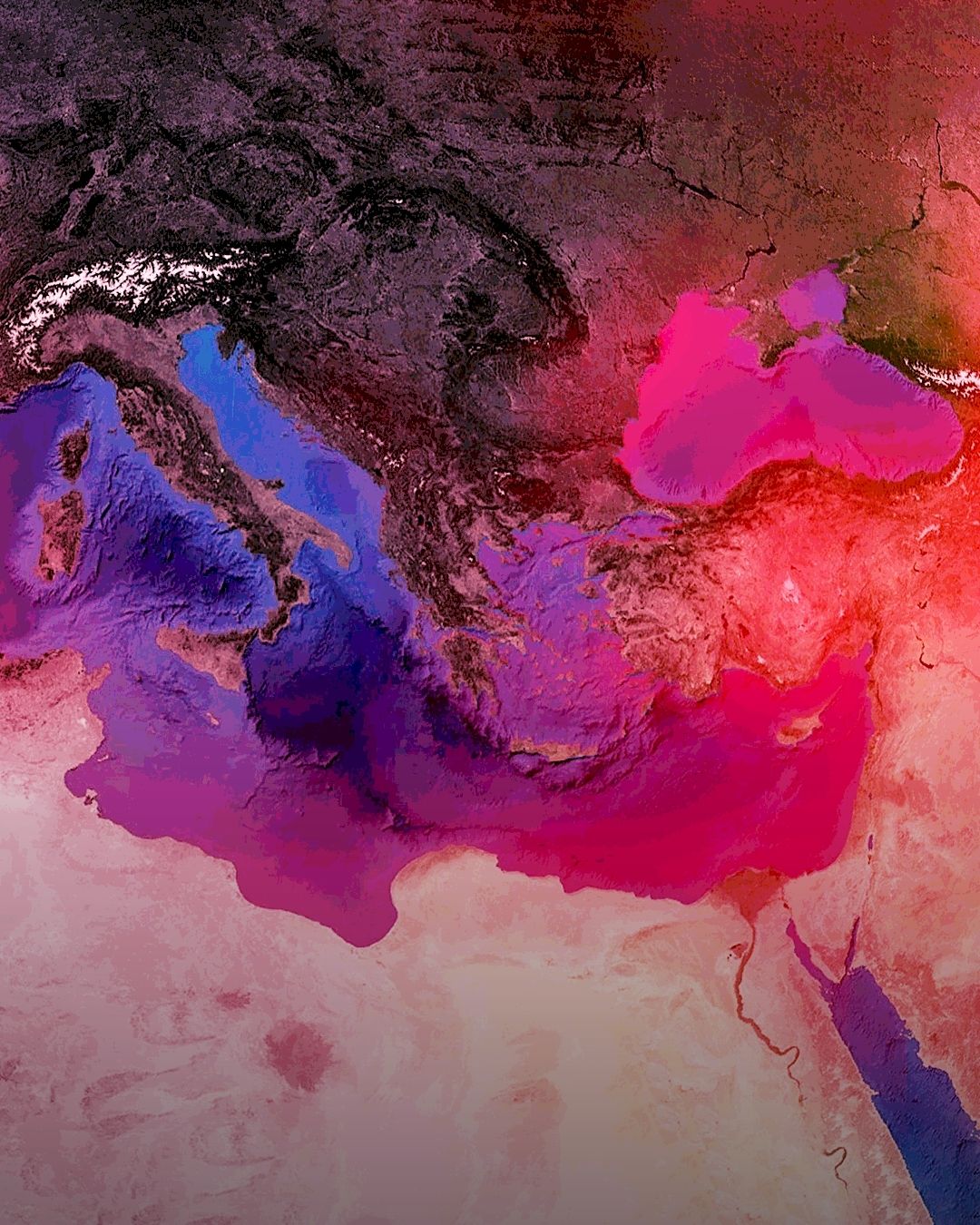
What indeed is the Mediterranean, where does it begin and where does it end, and what is today—centuries away from the mythological Punic Wars—the object of control for which medium and great powers are fighting?
The Mediterranean is the sea of three continents: Europe, Africa, and Asia. The convergence of this proximity is not just a geographical or territorial element.
When adding the connection to the Suez Canal, this continuity forms the transit route between the West and the Far East. This, too, is not just a geographical fact: 20% of global maritime traffic and 65% of the energy traffic bound for Europe pass between these shores.
As far as Italy is concerned, imports by sea account for 60% of the total, and exports from national ports make up 50%. In short, the maritime sector represents 3.3% of our total economy, with a value of 52.4 billion euros, employing 1 million people and serving 228,000 businesses (ISPI data).
But even before the economic aspect, the Mediterranean represents that intense culture created over the centuries, made of wars and expansionism, but also of exchange, multiracialism, and an incredible mixture of habits, customs, religions, and political models. After the Second World War, this anthropological mix seemed to find its own, albeit fragile, balance.
What has brought war—real, ruthless, heavy war—back to these waters, and what is at stake?
The Return of War
The main game has been reopened by the competition born precisely among the three continents facing the Mediterranean.
And while political Europe does not appear capable of intervening effectively in this competition, it certainly runs the risk of being crushed in the clash between East and West. We could say, perhaps with more precision, between the US and China. And even though the Mediterranean is not decisive for either of these two nations in their confrontation, what we see falling (and not just metaphorically) upon Europe and the sea that surrounds us is the result of weapons never tested before.
The novelty of the ongoing wars is that, while they are the children of the traditional logic of every war (control, expansion, sovereignism), they nevertheless break out as a consequence of technological evolution and its resulting values (the value of money, of political models, of the top-down or balanced relationship between people, of new hierarchies of power) which the combined revolution of technological development and globalization has built.
A New World
Today we are in a phase where a “new world”—the kind they used to sing about in Hollywood and hope for in the rest of the world after the Second World War—has been created. But along with its wonders, it has also brought chaos and disorientation. Among these is precisely the use of the sea, which has become a precious avenue for the transfer of power and control.
In an essay written by Mario Boffo for LAB/politiche e culture, titled “Enlarged or Restricted Mediterranean,” a list is compiled connecting the destinies of the sea with a strategic perspective of interests, expanding the concept of “interrelationality” between global commercial and political areas:
- Energy interdependence: the pipelines and infrastructures reaching Europe from the Middle East and Africa pass through the Mediterranean, but originate elsewhere.
- The new global routes: the routes connecting Asia, Africa, and Europe see key terminals in Mediterranean ports.
- A renewed military and diplomatic projection: NATO, EU, and national operations are no longer limited to the coastline, nor to the Mediterranean basin strictly considered in traditional terms.
- The regionalization of crises: conflicts and crises such as those in Libya, Syria, the Sahel, as well as the Palestinian conflict and the vicissitudes of Yemen, cannot be understood as isolated within a single country.
To understand what ignites these latest conflicts, it must finally be emphasized that they are not generated solely by the expansion of influence or defense.
The great shift in technology today makes competition decisive also in the fields of economics, technology, and energy resources, as well as in the control of routes and facilities.
Therefore, ports and global logistics, the defense of undersea cables through which 95% of global communications travel, the control of water sources, and climate change are all highly relevant. And then there is the human factor, meaning migratory routes.
Listed like this, as Boffo lucidly does, it appears less like a war and more like a revolution. Fernand Braudel, a staple author of our university studies, wrote: “The Mediterranean is what men make of it.” In short, it is up to us—the human factor—to rise from our comfortable certainties and state what we want to make of it.

Mediterraneo in fiamme
Leggi la newsletterGli articoli del numero 77 Dentro Beirut: dove la guerra attraversa tutti i confini Cipro e le contraddizioni di un’Europa smarrita di Arturo Marzano Energia e frontiere: la vera agenda del Piano Mattei per l’Africa di Lorenzo Bagnoli Un fantasma si aggira per il Mediterraneo di Lucia Annunziata Dal petrolio di Kirkuk ai gommoni della Libia: la fuga dei curdi iracheni di Nancy Porsia Dal Mediterraneo all’Indo-Mediterraneo: la nuova geografia del potere di Eleonora Ardemagni